بسم اللہ الرحمن الرحیم
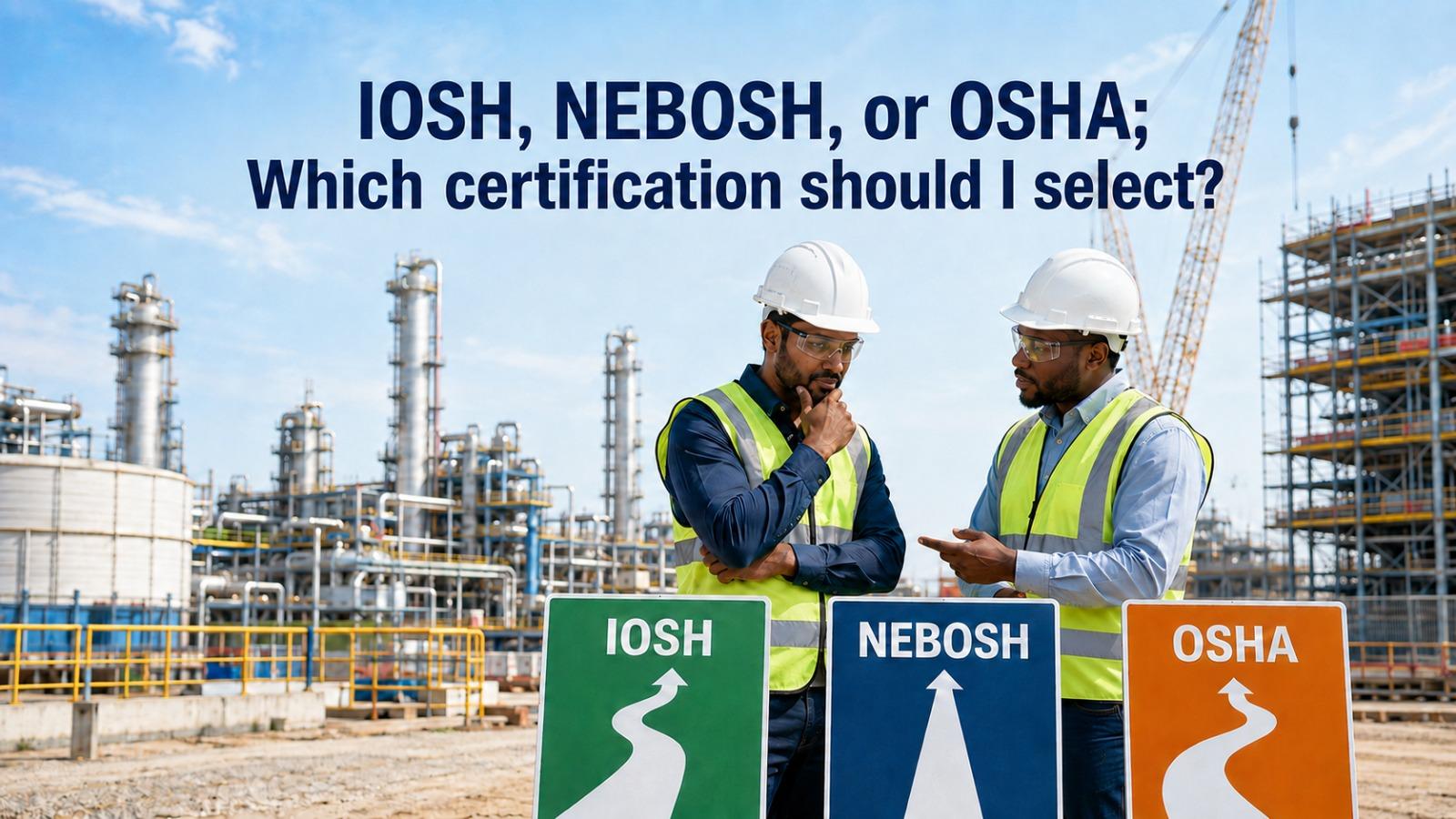
IOSH, NEBOSH or OSHA;
Which certification should I select?
IOSH, NEBOSH, and OSHA, are widely possessed, and acceptable, certifications - although the OSHA do have a second thought in industry which we will discuss further. In industry of training these are available in packages. But the question remains that do we need them, or do they fulfil our requirements?
IOSH Managing Safely, NEBOSH IGC, and OSHA 30 hours, are common certification, but referred just as “OSHA, IOSH, NEBOSH”. Even now a days the trend is driven from NEBOSH IGC to NEBOSH Level 6 diploma.
If you're a fresh professional working as a Safety Officer or Field Safety Representative, don't jump straight into the NEBOSH Level 6 Diploma. Instead, start with a basic or supervisory level certificate like IOSH Managing Safely. Once you've gained reasonable field experience, move on to the NEBOSH IGC, and then to NEBOSH Level 6 – if you are choosing NEBOSH path.
If, you're placed directly into a senior role without possessing ground level or factory floor experience, that gap will show up in your decisions and approach, and you'll feel it as well. Similarly, holding a high-level certification without matching field experience creates its own kind of learning gap.
This is exactly why certifications - like academic qualifications, are structured in different levels. Each is designed for a certain stage of knowledge and experience. You'll often see brochures stating "This course does not require any prequalification. However, knowledge of the field is required." What does it mean?
This is a polite way of saying that practical experience still matters, even without a formal prerequisite. Always prioritize what genuinely builds your competency, and let your experience and certification level advance together, step by step.
Let's outline a suggested career path for an occupational health and safety professional, and understand these certifications and their differences.
IOSH is a UK-based professional body that also offers training courses, such as IOSH Working Safely and IOSH Managing Safely. New professionals and field personnel are recommended to start with IOSH Managing Safely, which builds a strong foundation in hazard identification, safety management, incident investigation, and auditing.
Once you have a solid understanding of worksite operations and management functions, you can progress to NEBOSH IGC, which covers safety management in greater depth.
The same logic applies within NEBOSH certifications, start with the NEBOSH IGC, then move toward Level 6. If you're in or target other industries such as processing safety or oil & gas sector, you may proceed with those certifications of NEBOSH as well.
A note on qualification "levels", Level 3 or Level 6 labeling depends entirely on the national qualification framework it's assessed against. A certificate rated Level 7 under one framework might be broadly equivalent to Level 3 under another. Always cross check the underlying framework rather than relying on the level number alone, when selecting a certifications course.
Let’s talk about OSHA, it is fundamentally a US regulatory framework, so it's more accurate to think of it as regulatory compliance training rather than a professional occupational health and safety certification in the same sense as NEBOSH or IOSH. That said, in the Gulf market, courses like the OSHA 30-Hour General Industry or OSHA 30-Hour Construction Industry program are still widely accepted and often treated as valuable safety credentials.
OSHA itself does not directly deliver training internationally. Through OSHA's official Outreach Training Program, OSHA-authorized trainers are permitted to deliver the standard 10-hour and 30-hour courses outside the US and issue legitimate OSHA completion cards. So, for such trainings the Trainers should hold official authorization.
Why is OSHA training still valuable, especially in the Gulf and particularly in Saudi Arabia? OSHA course content tends to be very practical and ground-level. Where other certification materials might say something vague like "maintain a reasonable distance," OSHA content typically specifies an exact figure e.g., "2 meters" making it more directly applicable to real fieldwork.
Many Gulf standards, such as those of SABIC and Saudi Aramco, share similarities in OSH requirements, as their proprietary engineering and safety standards, reference and incorporate multiple international codes, including OSHA, ANSI, NFPA.
Therefore, familiarity with OSHA requirements gives you a strong overlapping knowledge base with these standards, which is genuinely useful for interviews and fieldwork in such organizations.
Summarizing the discussion, prioritize yourself first, acquire the certifications that genuinely enhance your competency and comfort while working in the field. Once real experience is paired with the right certification, your confidence will grow and at that point, pursuing a higher-level certification becomes truly beneficial rather than just a credential on paper.
Stay Connected, Stay Updated.
May Allah keep His blessings upon us, always.